
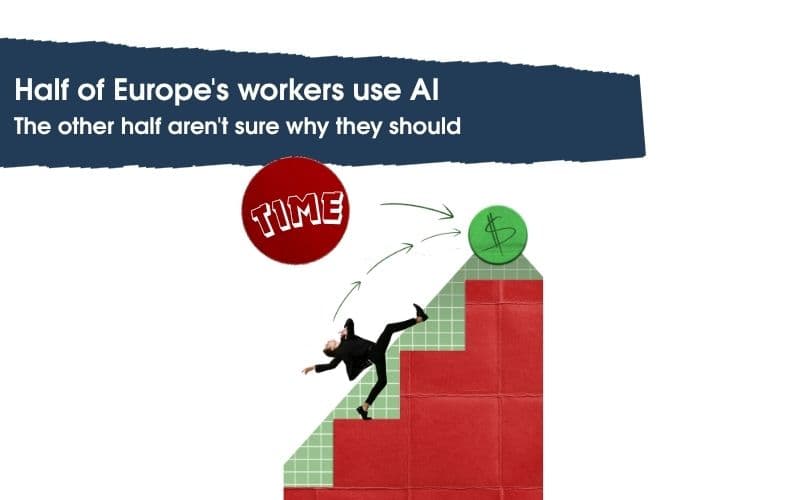
A new report from the European Central Bank puts a number on something most teams already feel: AI adoption at work has doubled in just two years, from 26% of workers in 2024 to 52% in 2026.
That's a majority. And the people using it are saving, on average, three hours a week.
The ECB's August 2026 blog post, based on a survey of roughly 20,000 workers across 11 European countries, breaks down which tasks save the most time, who's using AI most, and what's still stopping the other half from starting.
Three hours a week sounds modest. But when the ECB looked closer, the picture got more interesting.
Coding and debugging saved nearly eight hours per week for those who used AI for it. Data analysis and automating routine tasks came close. These are significant gains - but only about 8% of workers use AI for coding at all.
The most common uses - research, writing, text editing - saved the least time per task.
This creates an odd situation. The tasks where AI makes the biggest difference are used by the fewest people. And the tasks most people use it for are also the ones where the time savings feel smallest.
That gap matters. It suggests many workers are using AI in the most obvious way - typing a question, getting an answer - rather than integrating it into how they actually work.
One-third of non-users say AI simply isn't relevant to their work. But another large group said they prefer traditional methods, or aren't sure AI is accurate or reliable enough.
And 41% of non-users said they're just not interested.
When asked what would change that, the top answer was clear: better training on how to use it, and a better understanding of what it's actually useful for.
Half of firms plan to invest in AI training over the next year. The other half don't.
That gap between intent and action is where productivity gets left on the table.
The ECB data focuses on individual tasks. But one area it doesn't highlight is where most knowledge workers spend a disproportionate amount of time: meetings.
Managers - the group with the highest AI adoption rate and the most time saved - spend a significant portion of their working week in calls, status updates and team syncs. What happens inside those conversations often goes undocumented, summarised inaccurately, or forgotten.
Ulla joins meetings automatically and captures what was discussed - the full transcript, the key points, the action items, and who said what. No new habits required, no tool to learn before a call.
The time savings don't come from AI doing something new. They come from not having to do things that eat into the hours after every meeting: writing up notes, chasing people for updates, reconstructing what was decided.
For teams where meetings take up most of the day, that adds up faster than three hours a week.
The ECB report frames the remaining barriers as a training and access problem. That's true for some of it.
For meetings, the barrier is simpler. People aren't going to take notes differently because they were told to. The tools that actually save time are the ones that don't require anyone to change anything first.