
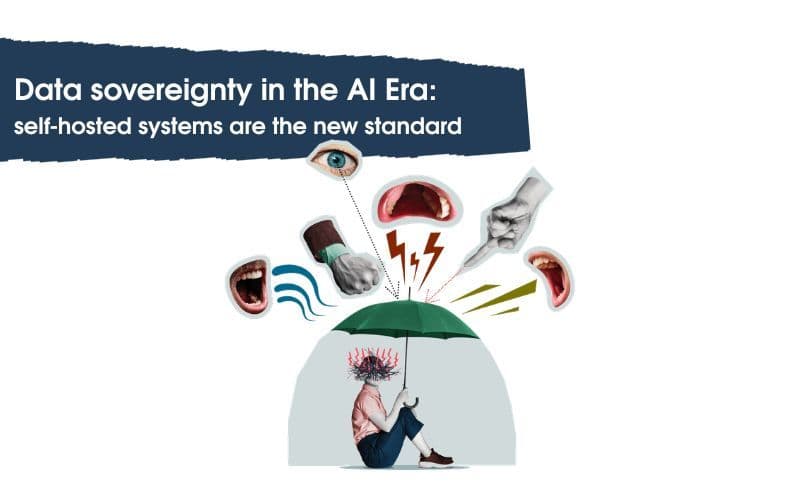
The landscape of corporate data security is shifting rapidly. Developments in March and April 2026 have forced a global conversation on where company data actually lives. As organisations move beyond simple automation, the focus has turned to "Digital Sovereignty" - the ability to maintain absolute control over every byte generated during the working day.
The Ecosystem lockdown
A significant move in this direction comes from Microsoft. According to recent updates regarding third-party recording bots, the platform is introducing stricter visual labelling and identification protocols for external AI assistants.
While the ability to manage guests in a "lobby" has existed for some time, this new level of transparency is part of a broader industry trend. Tech giants are increasingly prioritising the security of their own ecosystems, which places the responsibility back on the business to ensure that any external tool used is not just efficient, but fundamentally secure.
The rising cost of cloud vulnerability
The shift away from generic cloud AI isn't just about interface changes; it is a response to risk. Recent Data Breach Statistics suggest that the average cost of a breach in 2026 has climbed to $5.05 million.
When using standard cloud-based AI, sensitive discussions often travel through third-party servers. This creates a "shadow" layer of data that the business cannot fully audit. Industry analysts at Orange Business note that sovereignty is no longer just an IT preference - it is a core requirement for risk management.
The Case for Private Infrastructure
This is precisely why a Self-Hosted or Private Cloud approach is becoming the preferred architecture for the enterprise. By choosing this path from the outset, Ulla ensures that the "Human x Machine" synergy described by Deloitte happens within a closed, secure loop.
Key advantages of this architecture:
- Data confinement: meeting transcripts and engagement analytics never leave the internal perimeter. This eliminates the risk of sensitive information being used to train external models.
- Regulatory alignment: with the full implementation of the EU AI Act in 2026, having a verifiable, on-premise location for data storage simplifies compliance for legal, medical, and public sectors.
- Audit transparency: every interaction is logged and stored within the company’s own infrastructure, providing total visibility that cloud-only providers often cannot match.
Human synergy requires trust
People spend up to 60% of the working week in meetings. It is where strategy is born and where the most vulnerable team discussions take place. For AI to be a true partner rather than a silent observer, there must be an underlying guarantee of privacy.
AI should be a tool for better decision-making, not a means of data collection for third parties. In a world where data is the most valuable asset, keeping it under lock and key is the only logical move. Self-hosting isn't just a technical choice; it is a commitment to protecting the "Human Edge."