
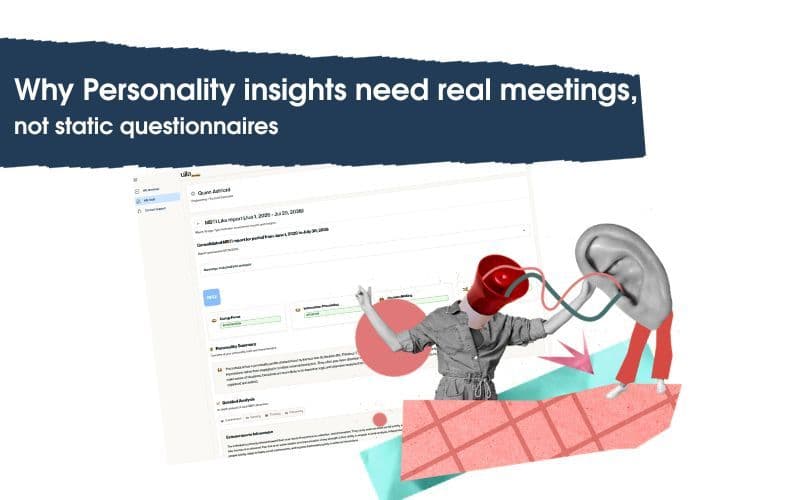
Most people fill out a personality assessment once, file the results away, and never look at them again. The problem is that how someone answers a questionnaire on a Tuesday morning often reflects their mood that day, not how they actually operate under pressure in a team.
If you want to understand how people communicate, make decisions, and perceive information, you have to look at what they actually do during real work.
Moving beyond self-assessment
Frameworks like the Myers-Briggs Type Indicator (MBTI) are popular because the 16 personality types give teams a common language for collaboration. Knowing whether someone leans toward introversion or extraversion, or how they process decisions, helps managers build balanced workflows.
However, traditional tests rely on self-reporting - how people think they behave.
A more accurate approach is tracking behavioural scoring through semantic analysis. By scanning meeting transcripts and leveraging broader communication contexts (such as comments in social media - an approach already supported by scientific publications confirming its viability), the system looks for specific conversational cues and recurring patterns associated with different traits.
- Accumulating data: Points are assigned when specific behavioural dimensions appear in context.
- Reaching a threshold: Once the system gathers enough consistent data across interactions, it generates a reliable, MBTI-style profile.
- Reflecting reality: Because it builds on actual communications, the resulting profile reflects how a person works in practice, not how they answered a multiple-choice test.
Making insights actionable
When personality frameworks are grounded in daily operations rather than static surveys, they become genuinely useful for personal development and collaboration improvement. They help team leads and HR professionals identify communication bottlenecks, clarify decision-making dynamics, and support individual growth - without adding extra administrative tasks to anyone's plate.