
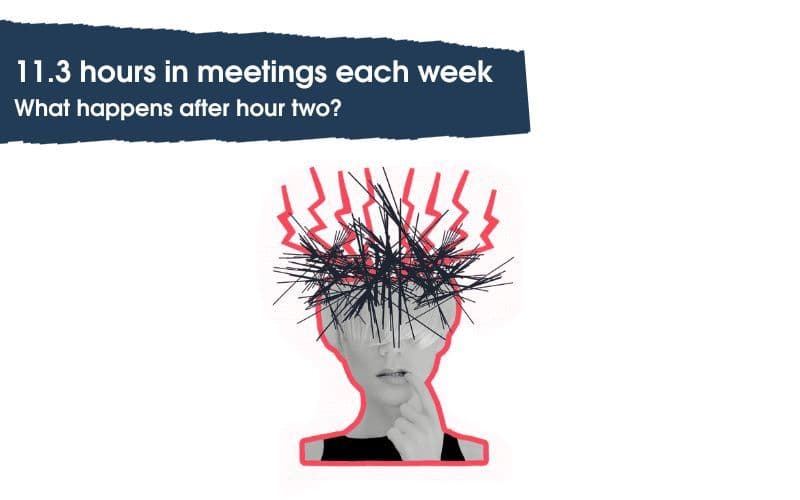
The average employee now spends 11.3 hours per week in meetings.
That number does not even shock anyone anymore.
What should shock you is something else.
Research shows that productivity drops sharply after around two hours of meetings per day.
Not after six.Not after a “crazy day”.
After two.
So what actually happens to the human brain after hour two?
Let’s zoom in.
The two-hour threshold
Two hours of meetings a day does not sound extreme.
That is:
- One team sync
- One project call
- A quick catch-up
Normal. Manageable. Civilised.
But cognitive research suggests that beyond roughly two hours of synchronous discussion, attention declines, working memory becomes strained, and decision quality drops.
In simple terms: Your brain gets tired of processing other people’s thoughts.
Meetings demand constant listening, interpretation, filtering, and response planning. That is high-load cognitive work.
After enough of it, the brain protects itself.
It starts conserving energy.
Which looks like:
- Passive nodding
- Camera on, brain elsewhere
- Slower responses
- Fewer original ideas
- Agreeing just to move on
And nobody notices.
The illusion of productivity
Here is the dangerous part.
After hour two, meetings often feel productive.
Everyone is still present.The agenda is still moving.The discussion continues.
But cognitive fatigue changes the quality of thinking.
People default to safer decisions.Risk appetite decreases.Critical thinking softens.
You get consensus.But not necessarily clarity.
You get alignment.But not necessarily innovation.
The meeting ends.The calendar moves on.
The cost is invisible.
Why this threshold matters
If the average employee spends 11.3 hours per week in meetings, that is over two hours per working day.
Which means many teams are operating permanently beyond the cognitive threshold.
Not occasionally.
Constantly.
Now add:
- Back-to-back scheduling
- No buffer time
- Context switching
- Notification interruptions
The brain never fully resets.
What we call “Zoom fatigue” is not just about screens.
It is about sustained social cognition without recovery.
What happens to decision quality?
Decision-making under fatigue changes in subtle ways.
People:
- Prefer familiar options
- Avoid conflict
- Skip deeper analysis
- Postpone complex choices
- Accept vague action points
Over time, this creates a pattern.
Meetings multiply because previous meetings did not resolve things properly.
And those extra meetings push everyone further past the threshold.
It becomes a loop.
The compounding effect
One long meeting is survivable.
Five medium meetings per day are not.
Because fatigue compounds.
By the third or fourth session, even strong communicators become quieter.
Junior employees speak less.
Introverts disappear into silence.
Dominant personalities fill the space more easily.
It is not always about hierarchy.
It is about energy.
And energy is not infinite.
Why “Just shorten meetings” is not enough
The common advice is simple:
“Make meetings shorter.”
That helps.
But it does not solve the threshold problem if:
- The number of meetings stays high
- There is no buffer between them
- Follow-ups are unclear
- The same topics return repeatedly
The issue is not just duration.
It is cognitive load density.
Two one-hour meetings back-to-back can be more exhausting than one two-hour workshop with breaks.
The data behind the feeling
Multiple workplace studies now show:
- A high percentage of meetings are rated unproductive
- Employees report lower focus after heavy meeting days
- Overload correlates with stress and disengagement
- Deep work time decreases as meeting hours increase
And yet calendars continue to expand.
Because meetings are easy to schedule.
Thinking time is not.
So what should leaders watch?
Not just total meeting hours.
But the daily threshold.
Ask:
- How many employees regularly exceed two hours of meetings per day?
- Are there buffers between sessions?
- Who speaks less as the day progresses?
- Do afternoon meetings generate fewer decisions?
These patterns matter.
Because once fatigue becomes structural, performance quietly declines.
Not dramatically.
Gradually.
Final thought
The average calendar now contains 11.3 hours of meetings per week.
That sounds manageable.
But if productivity drops after hour two per day, then many organisations are operating in a permanent state of cognitive drag.
Meetings are not the enemy.
But overload is.
And the most dangerous threshold is the one nobody tracks.
Two hours.
After that, you are not just meeting.
You are depleting.