
Artificial intelligence was supposed to make work simpler.
AI systems can analyse data faster than analysts, generate reports in seconds, and simulate complex scenarios almost instantly. In theory, this should reduce workload and accelerate decision-making.
In practice, many organisations are discovering the opposite.
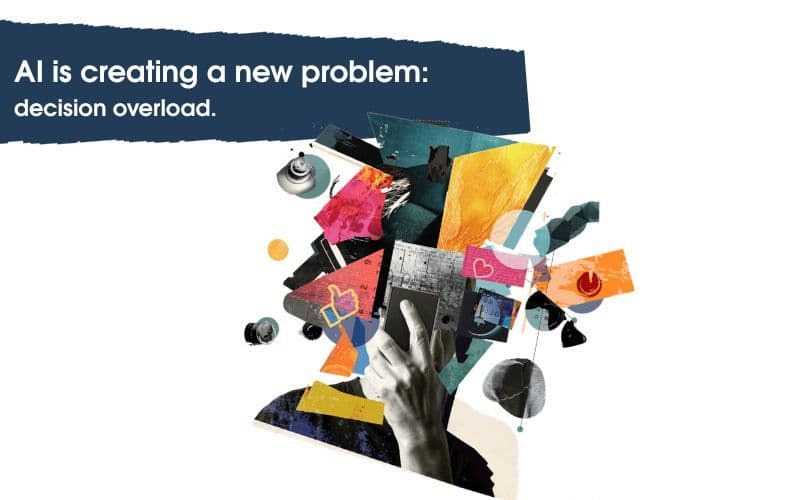
AI is not only producing answers faster - it is producing more answers than humans can comfortably process. The result is a new kind of pressure inside organisations: decision overload.
A 2026 MIT Sloan Executive Education article argues that the real challenge is no longer AI adoption on its own, but organisational adaptation - in other words, how companies redesign workflows, leadership habits and decision processes around AI. That matters because AI can speed up output without making judgement any easier.
AI can generate insights quickly.Humans still have to decide which ones matter.
More insight, More choices
Historically, many business decisions were constrained by limited information. Leaders often had to act with partial data and rely on experience or instinct.
AI has changed that dynamic completely.
Today a single system can generate multiple forecasts, scenarios or strategic options within seconds. Marketing teams receive several campaign variants generated by AI. Product teams see predictive models suggesting multiple possible directions. Finance departments can simulate different investment outcomes instantly.
While this abundance of information is powerful, it introduces a paradox: more options often make decisions harder, not easier.
Instead of choosing between two possibilities, leaders may now be evaluating ten. Each option requires discussion, validation and alignment.
The bottleneck shifts from producing information to interpreting and selecting it.
The shift from execution to judgement
One of the most important changes brought by AI is the shift in how work is distributed.
Machines increasingly handle execution tasks - analysis, drafting, pattern recognition, modelling. Human roles, in turn, become more focused on interpretation, judgement and oversight.
Deloitte’s 2026 Human Capital Trends research makes the same pressure visible from another angle. It says that 60% of executives now regularly use AI to support their decisions, yet only a very small share say they manage that process well. In other words, AI is already influencing decision-making at scale, while organisational oversight is still lagging behind.
This transition changes the structure of work.
Execution becomes faster.Decision-making becomes heavier.
And heavier decisions rarely happen alone.
They require discussion.
When decisions slow down
One might assume that better data would speed up organisational decisions. Yet many teams report the opposite effect after adopting AI tools.
That pattern is also reflected in Harvard Business Review’s 2026 article AI Doesn’t Reduce Work - It Intensifies It, which argues that AI often does not remove effort so much as redistribute and amplify it. People work faster, deal with a broader scope of tasks, and end up carrying more review, interpretation and follow-up work than expected. In that context, more insights do not automatically simplify decisions - they often make them heavier.
Instead of accelerating decisions, AI sometimes expands the review process around them.
The core issue is accountability. Algorithms can recommend actions, but humans remain responsible for the consequences. Because of that responsibility, organisations often add additional layers of review and alignment before acting.
Over time, decision cycles can become longer even while execution becomes faster.
The real bottleneck: decision visibility
If decisions are becoming the most expensive part of modern work, organisations need better visibility into how those decisions actually happen.
Where do decisions stall?Which teams repeatedly revisit the same topics?How many conversations occur before alignment is reached?
Traditional productivity metrics rarely capture this layer of work. They measure output - not the path required to reach it.
Yet in an AI-driven environment, understanding decision patterns may be just as important as measuring results.
From decision overload to decision clarity
AI will continue to increase the speed at which ideas, data and recommendations are generated. That trend is unlikely to slow down.
What organisations need now is not just faster tools, but clearer insight into how human decisions unfold around those tools.
This is where platforms like Ulla can play a role. By providing visibility into conversations, meetings and collaboration patterns, organisations can better understand where decision-making slows down and where alignment repeatedly consumes time.
AI may generate answers at unprecedented speed.
But progress still depends on how quickly people can decide what to do with them.