
The World Economic Forum’s 2025 report Four Futures for Jobs in the New Economy: AI and Talent in 2030 describes a workplace transformed by artificial intelligence. In its scenarios, AI copilots augment decision-making, automate execution, and accelerate productivity across industries. Human-AI collaboration becomes the norm rather than the exception.
It is an optimistic vision. Work becomes faster. Output increases. Skills shift toward judgement, creativity and strategic thinking.
Yet buried within that optimism is a tension most organisations are not discussing openly.
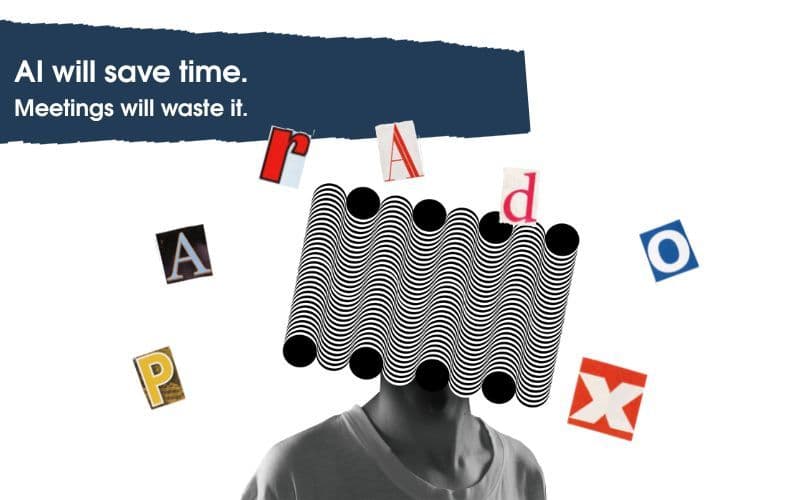
AI reduces task time. It does not automatically reduce coordination time.
And coordination is expensive.
The hidden layer of human-AI work
The WEF report makes it clear that the future is not about replacing humans. It is about augmenting them. AI systems will generate drafts, analyse datasets, produce insights and simulate outcomes. Humans will validate, interpret, refine and decide.
That sounds efficient. And in many cases, it is.
However, every AI-generated output introduces a new decision point. Someone must review it. Someone must question its assumptions. Someone must approve its direction. In practice, this means that as output accelerates, the volume of conversations often increases alongside it.
When machines move faster, humans must align faster.
Alignment, unfortunately, does not scale as elegantly as code.
When time saved becomes time reallocated
Organisations tend to assume that time saved through automation translates directly into productivity gains. If a task that once required three hours now takes one, the remaining two hours are expected to generate additional value.
In reality, those two hours are frequently absorbed by discussion.
Consider what happens when AI produces multiple strategic options in seconds. Instead of debating whether something is possible, teams now debate which of several possibilities to pursue. Instead of spending time drafting, they spend time reviewing and aligning. The centre of gravity shifts from production to coordination.
This shift is subtle but significant. The cost of labour does not disappear; it moves.
Time in meetings is time you pay twice
Meetings are rarely treated as financial events, yet they are precisely that.
If eight senior employees spend ninety minutes reviewing AI-generated recommendations, the direct salary cost is easy to calculate. Multiply the average hourly cost by the number of participants and the length of the session, and the figure quickly becomes substantial.
But the direct cost is only half the equation.
Those same individuals are not engaging in revenue-generating activities, strategic planning, client engagement or deep problem-solving during that time. The opportunity cost compounds the direct expense.
When AI increases the volume of material requiring review, it can unintentionally expand this coordination layer. The organisation pays once in wages and again in displaced productivity.
In that sense, time in meetings is time you pay twice.
Complexity grows before it shrinks
The WEF report suggests that by 2030 organisations will operate in more fluid, AI-integrated ecosystems. What it implies, though does not emphasise, is that complexity will intensify before it stabilises.
New tools create new workflows. New workflows require new norms. New norms require conversation.
During this transition, organisations often experience what might be called coordination inflation. Decisions take longer not because people are inefficient, but because there are more variables to consider and more stakeholders involved in validating AI-assisted outputs.
Without deliberate design, the promise of speed can become a paradox: faster execution paired with slower agreement.
The financial implication no one models
Few leadership teams model the financial impact of alignment overhead. AI investment cases typically focus on cost reduction, efficiency gains and time saved. They rarely include a line item for expanded review cycles or additional cross-functional checkpoints.
Yet if AI shortens production time by 25% but increases meeting time by 15%, the net gain may be far smaller than projected.
This does not mean AI fails. It means that productivity gains depend on how well coordination is structured.
The future of work, as outlined by the World Economic Forum, depends heavily on human skills such as judgement, collaboration and communication. These are inherently relational and therefore inherently time-consuming.
If organisations fail to manage that relational layer, the financial returns of AI adoption will erode quietly.
Designing for intelligent alignment
The answer is not to eliminate meetings or reduce collaboration. In complex environments, alignment is essential.
The challenge is to make coordination visible and intentional rather than habitual and reactive.
When organisations understand where decision loops repeat, where reviews accumulate unnecessarily, and which teams carry disproportionate alignment burdens, they can begin to redesign workflows accordingly. Documentation can replace repetition. Clear ownership can replace circular approval chains. Insight into collaboration patterns can reduce redundant conversations.
AI will undoubtedly change how work is executed. The question is whether organisations will change how work is coordinated.
If they do not, the time AI saves will simply be reallocated to meetings.
And the balance sheet will reflect that reality long before anyone admits it in a strategy presentation.
A final thought on visibility
If coordination is becoming the most expensive layer of work, organisations need better visibility into how it actually happens. Not just what was decided, but how long alignment takes, where conversations stall, and how often the same issues resurface.
This is precisely where tools like Ulla fit into the AI era. Not as another productivity add-on, but as a visibility layer over collaboration itself. When conversations, decisions and patterns become measurable, leaders can finally see where time - and therefore money - is being absorbed.
AI may accelerate output.But without insight into coordination, the gains will leak through meetings.