
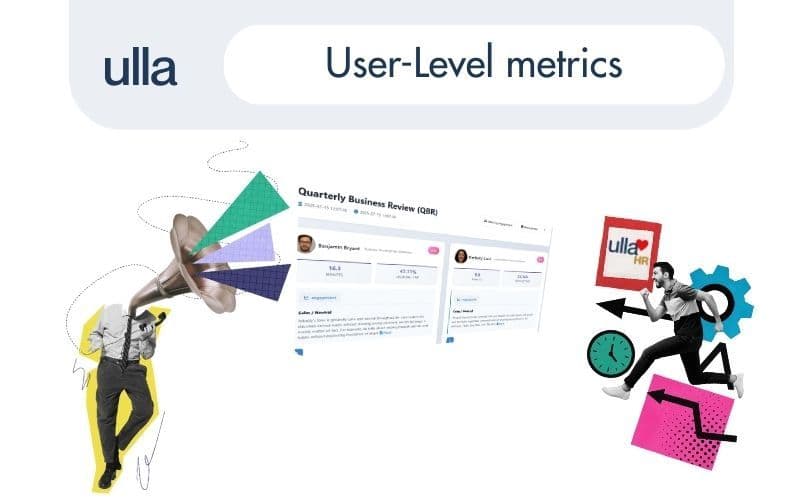
Most meetings feel like a blur - especially if you're juggling multiple ones every day. But over time, patterns begin to form: who contributes consistently, who stays silent, and who may be quietly burning out. While one meeting doesn't define a person, a series of meetings can start to tell a story.
That’s where User-Level Metrics in Ulla® HR Engagement come in.
As part of the Ulla® HR suite, this view focuses on the individual: their speaking patterns, consistency of participation, and engagement trends across multiple meetings. It’s not about judging performance - it’s about helping teams grow through data-backed self-awareness.
What are user-level metrics?
User-level metrics provide a consolidated view of how each employee communicates across meetings. Unlike meeting-level insights (focused on a single session) or organisational metrics (company-wide trends), this layer captures individual contribution and engagement over time — across all Ulla-tracked sessions.
You can see, for example:
- Average time spent in meetings per day
- Speech duration trends
- Patterns of participation across weeks or months
- Personality-aligned engagement markers like tone, clarity, collaboration, and response to feedback
These insights help teams understand how people show up - not just how often.
What’s included in user-level analytics?
The User-Level Metrics view in Ulla® HR Engagement consists of two key sections:
- Analytics Overview
- Meeting History & Engagement
1. Analytics Overview
This is where the high-level patterns emerge. For each employee, you can see:
- Average calendar meeting time
- Actual time spent in Ulla-tracked meetings
- Total speech duration
- Visual comparisons between scheduled and real engagement
- Speech consistency over time
It helps you spot potential overload, underutilisation, or even just fluctuations in communication habits.
2. Meeting History & Engagement
Here, you can explore how someone participated in each specific meeting - what meetings they attended, how long they spoke, and what their personal engagement markers were during that time.
This includes indicators like:
- Emotional tone
- Helpfulness & collaboration
- Speech clarity & positivity
- Reactivity to feedback
- Tone of communication
These dimensions are aligned with frameworks like MBTI and Big Five, giving HR teams an evidence-based view of communication styles - always with privacy and consent in mind.
Why it matters
User-level metrics don’t label or score employees - they offer context. And context drives better conversations: between managers and team members, across departments, or even within self-reflection.
It’s especially helpful when:
- You want to coach team leads on their meeting style
- You’re tracking early signs of burnout
- You’re designing training or L&D initiatives based on real needs
- You want to bring more balance to your internal meetings
Combined with meeting-level and organisational views, user-level metrics complete the picture - so you’re not guessing who’s engaged, overloaded, or ready for more responsibility. You’re building culture through insight.
Because when teams understand themselves, they work better together.