
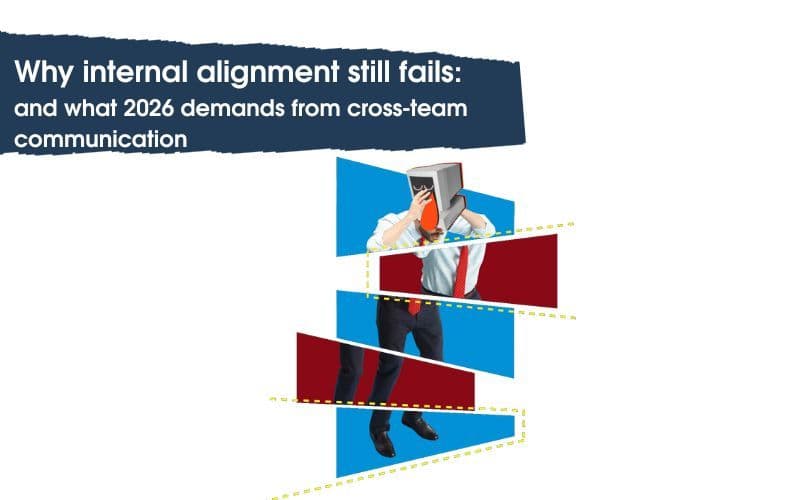
On paper, most organisations look aligned. Roadmaps exist. KPIs are defined. Strategy decks are shared. And yet, inside the company, teams often move in slightly different directions - sometimes without realising it.
This isn’t a motivation problem. And it’s not a lack of tools. It’s an alignment problem - and in 2026, it’s becoming one of the hardest challenges for managers to solve.
Alignment breaks quietly - not dramatically
Internal misalignment rarely shows up as open conflict. More often, it looks like:
- Teams agreeing in meetings but executing different interpretations
- Projects stalling because “we thought someone else owned this”
- Sales, product, and delivery teams optimising for different outcomes
- Managers spending more time clarifying decisions than making new ones
Research across HR and organisational studies in 2025 consistently points to the same pattern: misalignment grows in environments with high meeting volume, distributed teams, and layered decision-making.
The more communication happens, the easier it becomes to assume shared understanding - even when it’s not there.
Why managers miss the problem
One of the biggest misconceptions is that alignment can be measured by outputs alone: deadlines, delivery, or performance reviews.
In reality, alignment breaks much earlier - inside conversations.
Managers often don’t see:
- Which discussions actually move decisions forward
- Where conversations drift without resolution
- Whether key voices are consistently missing from critical meetings
- How often teams revisit the same topics without progress
By the time misalignment becomes visible in results, it’s already expensive.
2026 raises the bar for cross-team communication
As organisations enter 2026, several trends intensify the alignment challenge:
- More cross-functional work - fewer siloed teams, more shared ownership
- Hybrid and remote collaboration as a default, not an exception
- Faster decision cycles, with less tolerance for rework
- Higher cognitive load on managers juggling people, process, and delivery
What worked five years ago - long meetings, follow-up emails, informal “syncs” - no longer scales.
Alignment now depends on how teams communicate, not just what they decide.
What strong alignment actually looks like
Well-aligned teams don’t necessarily talk more. They communicate more clearly.
You see:
- Meetings with visible outcomes, not just discussion
- Balanced participation across roles and functions
- Clear ownership emerging during conversations, not after
- Less repetition of the same issues across multiple forums
Importantly, alignment is not about enforcing uniformity. It’s about ensuring that different teams understand decisions in the same way, even if they execute them differently.
From assumptions to signals
One reason alignment remains so difficult is that it’s often managed through assumptions:
“They were in the meeting - so they must be aligned.” “No one raised concerns - so everyone agreed.” “We discussed this last month - so it’s clear.”
In practice, alignment needs signals - not guesses.
Signals live in:
- How conversations unfold
- Who contributes, and when
- Whether discussions converge or keep looping
- How clearly decisions are articulated
Seeing those signals early allows managers to correct course before misalignment turns into friction, delay, or disengagement.
Where tools can help - without replacing leadership
Technology won’t create alignment on its own. That still requires judgement, context, and human leadership.
But in 2026, managers increasingly rely on better visibility into communication patterns to support those decisions - especially across large or distributed teams.
Used responsibly, analytics can help highlight:
- Where communication breaks down across teams
- Which meetings fail to translate into shared understanding
- Where alignment needs reinforcement, not enforcement
This is where tools like Ulla come into the picture - not to dictate decisions, but to surface early signals that help managers notice misalignment before it becomes costly.
Alignment isn’t a one-time achievement. In 2026, it’s an ongoing practice - built on clarity, shared understanding, and the ability to see what’s really happening inside team conversations.